Quick Summary: Two electric chain hoists with the same rated capacity can lift very differently once production gets busy. This article explains seven details that decide the difference: motor heat and duty rating, speed, headroom, chain wear, brake and limit switch health, supply and site conditions, and how operators use the pendant. It also gives a checklist of questions to ask before ordering and answers seven common buyer questions.

Introduction

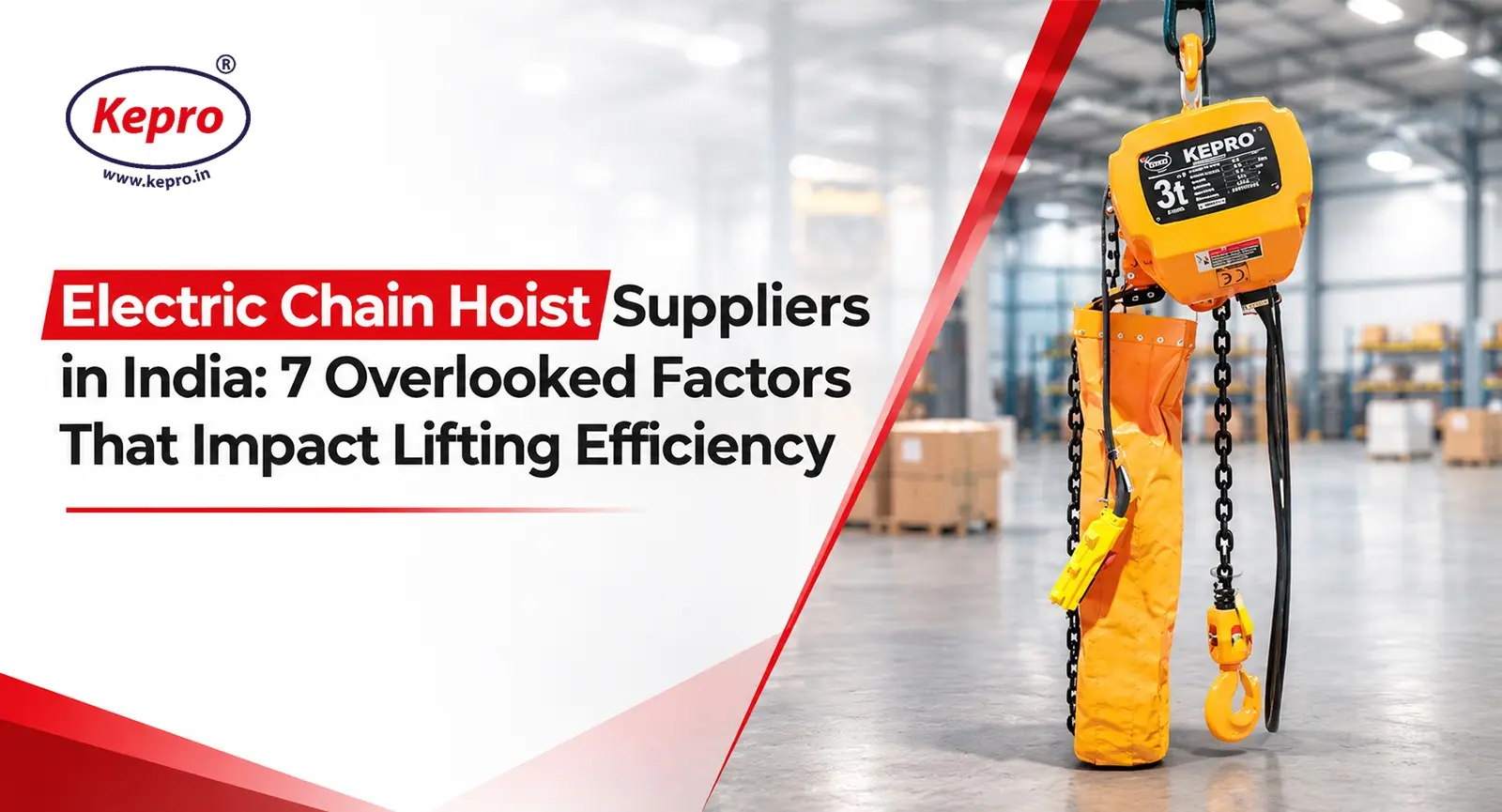
A chain hoist is rarely the reason why lifting slows down. The crane is the reason behind this, or the crew, or the schedule. Yet the cause can be inside the hoist itself. An electric chain hoist lifts and lowers loads with a motor driving a load chain, and factories, warehouses, workshops, power plants and shipyards use it where a hand hoist would be too slow. Capacity matters, but this is only one part. Two hoists with the same rated capacity can work very differently once production gets busy. Duty rating, speed, headroom, chain condition and supply conditions decide how much lifting you actually get from a shift. The difference shows up quickly. This article covers seven overlooked factors that shape lifting efficiency, from motor heat to pendant habits. A buyer’s checklist for Electric Chain Hoist Manufacturers and answers to common buyer queries follow, so you can choose and run a hoist with fewer surprises.

Seven Details That Decide How Much Gets Lifted

Each detail below is easy to miss when comparing the chain hoist, yet each one changes what your hoist delivers on the shop floor. These details are as follows: 

1. Motor Heat and the Duty Rating

Motor heat decides how long an electric chain hoist can keep working. The duty rating, shown as percent ED, states how much of each hour the motor may run: at 40 percent ED, that is 24 minutes in every 60. Starts count too, because exceeding the allowed starts per hour can overheat a motor even inside its ED rating. Count your lifts per hour before buying.  

2. Speed Matched to the Task

A single-speed hoist forces a compromise: fast enough to save time, yet slow enough to place a load gently. Dual-speed models resolve it, letting operators lift quickly through open travel and slow down for final positioning. Speed saves time only when the lift is long enough to use it. We offer dual speed versions of its Tauro and Tornado series, and lists adjustable lifting speeds among its key features.

3. Space You Cannot Add Later

Headroom is the distance from the beam to the hook at its highest position. A bulky electric chain hoist body takes a lot of space, and every centimetre lost is lifting height you cannot use, which matters in low sheds and crowded bays. Compare that figure with your available clearance before you order.

4. Chain Wear and Lubrication

The load chain wears quickly without giving any signs. Dirt and old grease can hide signs of wear, so keep it clean and lubricated, and measure elongation instead of judging by eye. Discard limits differ by maker: one guide cites about 2 percent of pitch, while another maker’s maintenance plan checks for 5 percent. Follow the limit in your hoist’s own manual, and replace the chain at that point, not later.       

5. Brake and Limit Switch Health    

The brake and limit switches protect both the load and the hoist, so test them before use. A released button should leave the load stopped and held, and actuating a limit switch should stop the electric chain hoist. Stopping-distance checks differ between models, so use the figure in your hoist’s manual. A periodic inspection by a competent person, every 12 months in one maintenance guide, covers what daily checks miss.   

6. Supply Voltage and Site Conditions   

Match the hoist’s voltage to your supply, and recheck phasing and limit switch operation after any voltage conversion, as one maker’s maintenance plan advises. Choose the protection class to suit the site as well, for example IP54 or IP55, according to one buying guide. 

7. Pendant Habits and Inching

Pendant control puts efficiency in the operator’s hands. Every tap of the button is a motor start, and one maker’s selection guide counts inching when calculating starts per hour. Repeated tapping to position a load can therefore use up a hoist’s start allowance. Train operators to plan each move before they press the button. 

Check these seven details together, and a quote starts to say more than its capacity figure.

What to Ask Before You Place the Order

Put these questions to every one of the Electric Chain Hoist Manufacturers on your shortlist. These questions are as follows: 

  • Duty rating: What is the ED percentage and the maximum starts per hour?
  • Speed options: Is a dual-speed or variable-speed model available for this capacity?
  • Headroom: What is the hook’s highest position under the beam or trolley?
  • Chain: What is the discard limit for elongation, and which lubricant do you specify?
  • Protection: Which IP rating and voltage options suit our site?
  • Testing: Is each hoist tested before dispatch, and can you share the certificate?

Clear answers to all six usually mark a maker who knows its hoists well.

Conclusion

Lifting efficiency is rarely lost in one of the major failures. It leaks away through overheated motors, wrong speeds, lost headroom, worn chain, tired brakes and heavy-handed starts. Kepro India has supplied lifting equipment across India since 1993 and lists electric chain hoists up to 50 tons, so bring your lifts per hour, clearance and site conditions to that conversation early. Compare every single machine on those same terms, and choose the hoist that fits your working day, not just your heaviest load.

FAQs

An electric chain hoist can lift capacities up to 50 tons and a lifting height of 100 metres, and it describes 1, 2, 3 and 10 ton models. Confirm the exact capacity and lift for your specific model. Capacity is the ceiling, not the daily working norm.
An electric chain hoist lifts with an alloy steel load chain, while a wire rope hoist uses wire rope. We make both types, so compare capacity, lift height and duty class for your application.
An electric hoist can be used in automobile manufacturing and maintenance, entertainment and stage rigging, mining, oil and gas, and port terminals among its applications.
Yes, there are some specific standard hoists which can work in hazardous areas, but not all of them can. We properly list explosion proof and non sparking chain hoists, so state your area classification at enquiry and request the relevant certification.
Yes, some of these manufacturers do offer services across India. We have described a nationwide distribution network and service stations for pre- and post-sales services, with locations listed in Kolkata, Haridwar, Delhi, Ahmedabad and Chennai.

Kepro

Kepro Technologies Pvt. Ltd. is a leading Indian manufacturer of lifting equipment. We have been providing innovative solutions across industries like construction, railways, and oil & gas since 1993.

Related Posts